The Two-Antibody Problem: Announcing the BigHat-Anthropic Partnership
Share


Share
The Two-Antibody Problem: Announcing the BigHat-Anthropic Partnership
Today, Anthropic and BigHat Biosciences announced the results of their antibody optimization pilot. This marks one of the first instances of a frontier AI lab and a next-gen biotech teaming up to develop novel therapeutic candidates.
Antibodies are among the most effective drugs ever made, and the single largest pharma category by revenue. With indications in oncology, neurology, autoimmune disease, infectious disease, and many other disorders, they represent some of the most elegant and versatile breakthroughs in medicine.
Those breakthroughs require overcoming numerous challenges, including intricate 3-D protein folding, thermal stability, permeability, exquisite target specificity, and the risk of adverse immune responses. Improving one property often affects others, compounding already long and expensive design cycles. This is referred to as the multi-parameter optimization problem in biologics design.
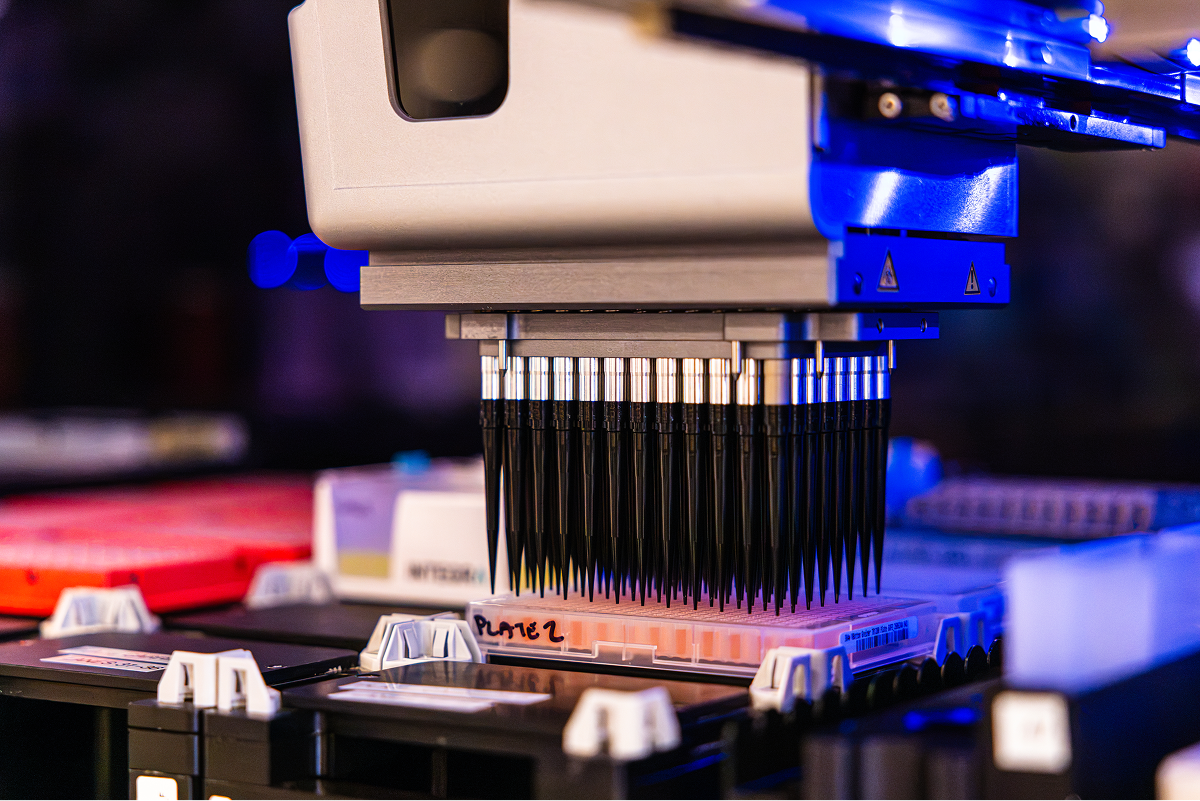
Frontier AI has started to demonstrate interesting therapeutic ideas, but is still rate-limited by real-world experiments to iterate on molecular design. We have always held that the workflows of the future will be defined by the interplay between AI models and lab-in-the-loop experiments.
Enter BigHat, a pioneering company in biologics design, now rapidly operationalizing AI drug discovery. Years before mass-market LLMs, BigHat began building the definitive data generation platform from first principles, along with their own AI capabilities. Today, frontier labs and neolabs are moving into experimental bio, and BigHat is poised to become their preferred engine for exquisite, high-throughput verification.
BigHat’s platform comprises three foundations:
- Milliner: an automated synbio wet lab, using cell-free protein synthesis to produce thousands of novel molecules per week.
- Reccy: A unified data control plane, ensuring total traceability from design to optimized molecule.
- RADS: Production ML/frontier intelligence, training hundreds of models on BigHat’s proprietary data.
BigHat’s first collaboration with Anthropic showcased the emphatic arrival of scientist-agent teams in real-world drug creation. Over seven rounds, an Anthropic researcher and Claude used BigHat to optimize two antibodies. The most improved variants bound targets up to nine times tighter, remained folded up to 17°C higher than the parental antibody, and aggregated much slower. The “how” was as striking as the “what”, as Claude leveraged expert reasoning, rather than specialized models, while working through 1,232 designs.
For 8VC, this was a dramatic proofpoint for our long conviction in BigHat. We led their Seed round in 2019, and have participated in each subsequent round. We’ve enjoyed a front-row seat to many milestones, including the first BigHat-designed drug to reach the clinic.
As a pilot for the broader Anthropic-BigHat partnership, this collaboration shows how the technical bottleneck has shifted from models to data infrastructure, and how the research focal point has shifted from libraries of well-trodden compounds to labs that can generate and validate optimized molecules in rapid succession. The next phase will be defined by an evolution from narrow, upfront parameters to open goals—including targets so challenging that they largely precluded large-scale investment in recent years.
A blueprint is emerging for how bio labs partner with frontier labs, how scientists and agents can iterate side-by-side, and ultimately, how AI can supercharge biodiscovery. Bringing desperately needed treatments to patients remains biotech’s North Star. By marshaling its collective knowledge, reasoning, and imagination, the field is moving, through its hardships, ever closer.
Share
Continue Reading