The AI Wave
Share



Share
Introduction
Since the advent of Silicon Valley, we’ve seen six major technological waves: “Electronic Tools,” “Semiconductor,” “Enterprise,” “Telecom,” “Consumer”, and “Smart Enterprise.” We can now add a seventh: AI Applications & Services.
In early 2013, we published our whitepaper, The Smart Enterprise Wave, predicting the B2B software renaissance that’s been a core pillar of our investment strategy ever since. Smart Enterprise brought platform approaches to complex workflows across numerous industries (finance, defense, government, real estate), launching an era of considerable value creation.
Technology is fundamentally an enabler. Each wave expands the set of solvable problems, and value accrues to those who bridge the gap to solve them. Smart Enterprise was predicated on the capabilities of its time: cloud & big data. AI is the newest wave, expanding what's possible for existing companies that have done the hard work of consolidating data and workflows, and opening the door to categories that were previously out of reach.
The best Smart Enterprise companies can now deploy AI on top of dominant platforms. Those that never achieved true platform status or data moats have no such advantage, and their post-ZIRP valuation decline will continue. Meanwhile, industries that once faced structural limits to software adoption, like workflows dominated by unstructured data or expertise-driven decisions, are finally addressable.
How Did We Do?
Since our whitepaper, there have been just over 120 SaaS IPOs overall. Over the same period, 8VC Smart Enterprise companies have modernized entire industries, created billions in EV, and laid critical foundations for continuing success in the AI wave. Below, we review five standout examples from our portfolio, spanning vertical and horizontal approaches and a wide spectrum of markets.
- Palantir debuted at $26B in 2020, surging to over $400B in market cap today. Along the way, they’ve won numerous Programs of Record, spurred much-needed acquisition reforms, mainstreamed the importance of ontology, and built AIP, the most dominant enterprise AI platform on the market.
- Addepar was founded as an operating system for finance, unifying siloed portfolio and securities data, enabling efficient exchanges, and helping RIAs give clients the best options. Today, Addepar manages over $8T in assets for over 1,300 investment firms.
- OpenGov brought a platform approach to the fragmented local govtech market, and now serves thousands of state and local governments, powering workflows across budgeting, planning, permitting, asset management, etc. In 2024, Cox Enterprises acquired OpenGov for $1.8B.
- Qualia introduced a single platform for real estate closings, convening buyers, sellers, realtors, lenders, and title/escrow agents for maximum efficiency and transparency. Today, Qualia is used by over one million industry professionals.
- Asana became the leader in project management and collaboration, and now does over $750mm in ARR.
Smart Enterprise Revisited
With our whitepaper approaching Bar Mitzvah age, and AI now ubiquitous, it’s time to revisit the Smart Enterprise thesis—where it’s been, and where the AI wave is taking it. We wrote that “In the Smart Enterprise space, companies are re-inventing and replacing the decades-old technology infrastructure behind major industries. To accomplish this, engineers are solving hard technology problems involved in integrating disparate data into conceptual structures that knowledge workers can intuitively access and manipulate.” Smart Enterprise technologies followed a general playbook:
“1. Integrate heterogeneous big data and empower knowledge workers to solve non-linear problems.
2. Leverage recent IT advances [cloud and big data]—chiefly from the consumer wave—to solve critical challenges in major industries.
3. Harness network effects within industry verticals and become platforms, increasing innovation by enabling novel applications to quickly spread throughout the industry.”
How Work Is Changing: Enablement to Execution
“Non-linear problems” is the operative term, signifying extensive business logic, complexity, and mostly unstructured data. The Smart Enterprise wave enabled us to gain visibility into high-value workflows, automate basic data management, and better inform our decisions. The AI wave lets us automate the decisions themselves—along with much of the underlying work.
Advances in models and agents have catalyzed technology that can reason on its own about the data it's given, in an agentic loop. On top of the Smart Enterprise platform creation blueprint, this is a historic development. Over the next decade, we’ll see the real-time productivity impacts of AI, proving exactly how powerful the AI wave will be relative to its predecessor.
While these waves can be partly understood through an automation lens, humans have remained critical to the equation. From the early days of Palantir, we took inspiration from JCR Licklider’s “Man-Computer Symbiosis”. In contrast to a future of machine overlords, the goal was to raise the bounds, and value, of human achievement, as machines “climbed the pyramid” from automating busywork to progressively greater conceptual challenges. In 2010, that climb was largely theoretical. Today, we’re seeing it release to release—and strong Smart Enterprise companies are a key part of the story.

Slide from Joe’s 2010 TedX talk on man-machine symbiosis.
Fieldguide, a platform for audit & assurance/risk advisory firms, is an excellent illustration. Prior to Fieldguide, these firms relied on a patchwork of tools for governance, risk management, and compliance (GRC), which were conceptually limited to single components of the auditor’s workflow, and required extensive manual data collection and organization. Pre-AI, Fieldguide not only created checklists, pulled required documentation, and generated reports, but also built the concept of centralized data mapping across frameworks into the product, slashing redundant tasks and allowing auditors to build on earlier work. Now, Fieldguide actually performs meaningful portions of skilled work, i.e. running tests on framework requirements—and it’s far from alone in doing so.
Today, the question for Smart Enterprise companies is: will they harness the full force of the AI wave, or wipe out? An 8VC portfolio CEOs (9-figure revenue) put it succinctly in a recent all-hands: “The span of revenue outcomes is anything from $0-500MM, depending how right we get the AI piece—and this holds true for every prior-generation software business of this scale.”
AI’s Endless Summer
As detailed in “A Summer of AI In San Francisco”, we classify the AI ecosystem according to six tiers:
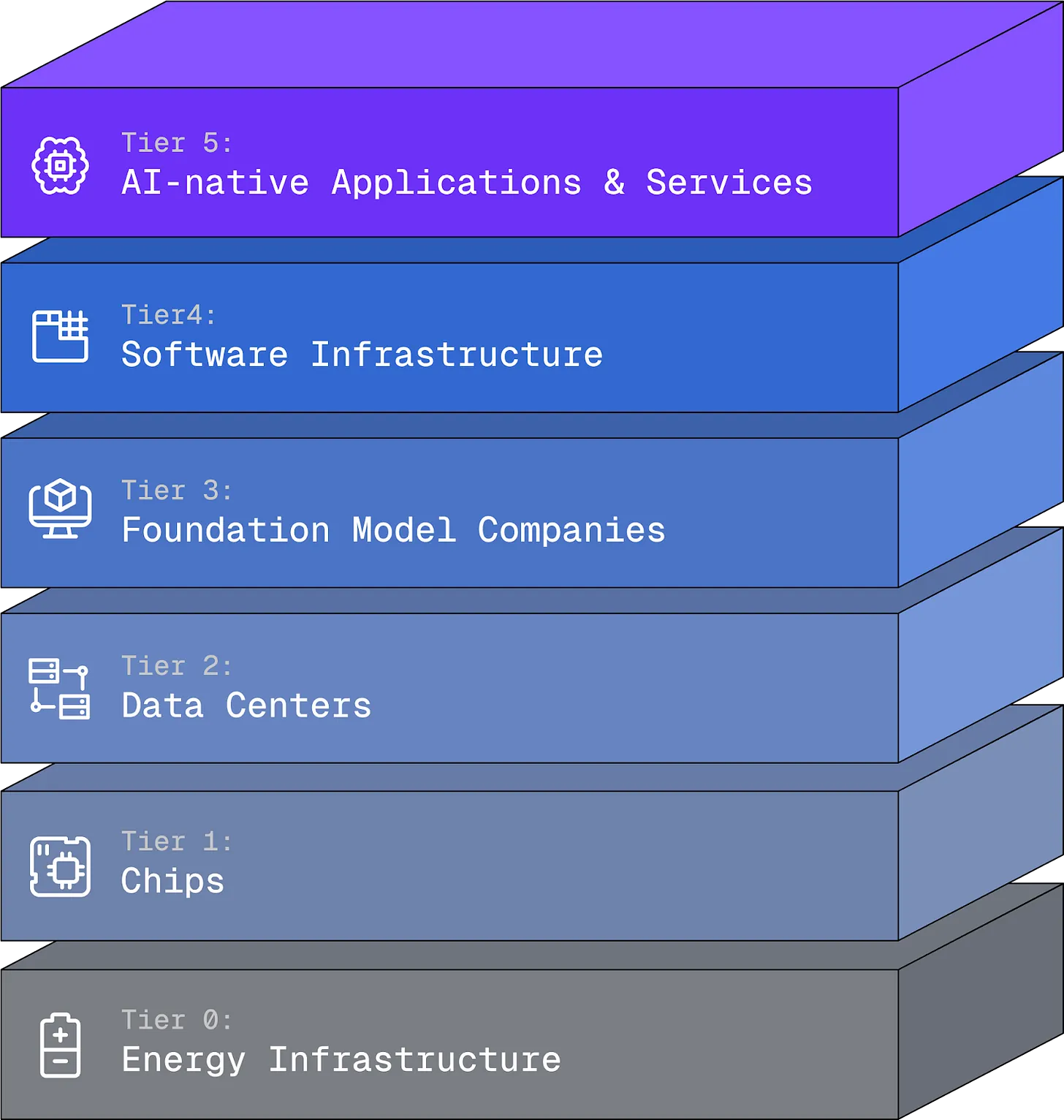
Within Tier 5, we divide companies into three general categories. Use-case specific software encompasses both (a) Existing Smart Enterprise companies that have meaningfully reoriented themselves around AI and (b) AI-native companies tackling industries and functions that are only becoming addressable now. Full-stack services offerings form their own category, which we’ll simply call (c) AI Services.
When evaluating AI investment opportunities in categories (b) and (c), we look at the following areas:
- High volumes of repetitive, document-centric tasks;
- Workflows reliant on legacy interfaces and portals;
- Knowledge-heavy tasks requiring judgment and decision-making, but where process is in place or extractable.
What’s striking is that each of these could have applied to many of the first-generation Smart Enterprise use cases—they’re just exponentially truer now. Thanks to this evolution, it’s increasingly clear that many of the best AI use cases are found in severely supply-constrained companies. By unlocking work, AI allows them to grow without scaling headcount.
Today, the optimism is infectious, driven by breakthroughs in:
- Document processing; extraction of structured data from unstructured
- Browser automation and desktop automation mediated by codegen
- Conversational and voice agents
- Advanced research via web and iterative LLM calls
- LLM synthesis and summarization
Document processing in particular shows how far things have come. In the Smart Enterprise whitepaper, we gave an example where “{intelligence} analysts can complete complex tasks—like tracking international money-laundering schemes or re-building communities in war-torn areas—that require connections across networks informed by structured and unstructured data.” Integrating structured and unstructured data was extremely valuable in itself, but the original Smart Enterprise platforms needed structured data to perform process automation. Drawing connections across structured and unstructured data remained a mostly cognitive/manual process. While LLMs can write, their true value is a function of their ability to read and reason.
8VC Portfolio Spotlights
Within the 8VC portfolio, all three categories of present-day, AI-driven Smart Enterprise are represented:
First-Generation Smart Enterprise: These companies have made the successful transition to becoming significantly more assistive or automated. LLMs enabled the logical evolution of the product, building on best-in-class data integrations and workflow consolidation. In addition to Fieldguide, standout examples include:
- Addepar has built on its position as the operating system of finance to pioneer such capabilities as complex workflow automation, AI usability assistants, and risk and opportunity intelligence.
- Qualia masterfully concentrated data, workflows and key relationships across title and escrow, teeing themselves up to deploy powerful, accurate AI features for document processing, data import, and messaging and coordination across parties.
- Casetext created groundbreaking tools for legal analysis, bringing much-needed data integration to case law, incorporating novel (at the time) NLP and ML techniques, and eventually serving over 10,000 firms and legal departments. With the advent of GPT-4, Casetext was able to build a true AI legal assistant, leading to a $650mm acquisition by Thomson Reuters a decade after its founding.
2) The Newly Possible/AI Natives:
- Bobyard: In the past, landscaping workflows were too small and the data too fuzzy/visual. Now, you can build an enterprise that’s generalizable to other trades involving project bids, eventually encompassing the entire built environment.
- Cognition: While previous coding tools delivered marginal efficiencies at best, Devin fundamentally represents a new unit of work. Where Jira once allowed for bug tracking, Devin can now bugbash autonomously, while developers spend more time developing.
- Outset: AI-led qualitative research is a quantum leap from both spotty surveys and traditional user interviews. Outset asks intelligent followups and elegantly synthesizes findings for less than $1.00 a session, while maximizing the insight of human subjects.
3) AI Services:
The limitations of legacy enterprise software are especially pronounced in the services economy, which includes many of the examples from our whitepaper: healthcare; local government; business services. As we wrote in our October 2024 AI Services thesis, “Software might have eaten the world in the last decade, but it left plenty of legacy services industries on the plate.” By our estimates, the American services sector spends ~$5T annually on labor that is now exposed to automation.
In many service industries, total factor productivity has declined over the last two decades, even as IT spend has grown. Paper and on-prem systems of record stubbornly persist, and SaaS adoption remains marginal. AI services are a radical departure from these norms, as they map and automate meaningful units of labor in conjunction with human experts. At their most ambitious, these companies are at once building enterprise platforms and services firms.
- Loop addresses freight audit and payment, where historically, carriers lose billions of dollars per year to audit errors, and spend tens of billions on low-tech outsourced service providers. Loop fuses AI/software capabilities with an expert operations team to handle the full spend management cycle, unlocking savings untouched by point solutions and legacy firms alike.
- Arcos is a new law firm transforming legal tech from digital filing cabinets to a core enabler of the practice. Traditionally, the complexity of legal procedure and documents generated the profits. Arcos maps the intricate logic of law in order to automate complex, dependent workflows and draft watertight documents, while attorneys focus on legal nuance, edge cases, and building irreplaceable institutional knowledge.
The Once and Future Ontology
The word “ontology” is notably absent from the Smart Enterprise whitepaper (even if it’s implied by “integrating disparate data into conceptual structures”). Frankly, it seemed too wonky at the time. Now, the concept is much more widespread, and we can recognize ontology as a common thread from Smart Enterprise 1.0 to today. We could even say the first job of Smart Enterprise founders was to lay the ontology groundwork for their respective domains.
Ontologies have undergone two major evolutions in the AI wave. The first is that ontologies give models sufficient content to reason from unstructured data (arguably the “smartest” thing AI does), grounding LLM-powered systems in reality and reducing hallucinations. It’s also worth noting that many of our early Smart Enterprise investments, i.e. Qualia, amassed extensive, high-quality structured data, which made it even easier to layer in new AI products.
The second is that ontologies originally mapped only the data layer, and today they map the workflow layer. This includes mapping what can be automated, what should be augmented when model capabilities improve, and where humans should remain in the loop. In turn, this conceptual mapping of the workflow serves as the foundation for the tool-calling required to do the work.
Today, a well-structured ontology is the core of all of our vertical AI companies. One of the key advantages AI adds to these companies is a simple means to ingest and map data to that ontology, without explicitly creating intake modules or writing bespoke transformation scripts. All workflows build on the ontology in perpetuity. Palantir is perhaps the ultimate example, as it became exponentially more valuable with the ability to layer AI on top of Foundry. While AIP can be a standalone, document-focused product, doing the hard work of ingesting all your data into Foundry creates countless new applications. It’s no surprise that Palantir alumni have launched so many top companies since the beginning of the AI wave, including Candid Health and Edra.
In Summary
The Smart Enterprise thesis was a departure from legacy software, as narrowly defined linear forms gave way to more conceptually powerful systems assisting non-linear, real-time decision-making. Now, with AI applications and services, the software itself can be “smart” enough to do open-ended work, as opposed to rote tasks. This leaves untold value to be captured by both Smart Enterprise pioneers, and the AI-native and AI services companies addressing workstreams and markets untouched by the first generation of Smart Enterprise. Where the previous wave revolutionized preparation, the current is revolutionizing productivity. The economic and societal stakes, and excitement, have never been higher.
Share
Continue Reading



.png)